Preventive Termite Control Services Every Property Owner Should Know

Termites rarely make a dramatic entrance. They work quietly, often for months or years, behind drywall, under flooring, inside crawl spaces, and along foundation lines. By the time a property owner notices bubbling paint, hollow-sounding trim, sagging floorboards, or a door frame that suddenly feels soft, the colony has usually been active long enough to do more than cosmetic damage.
That is what makes prevention different from response. Reactive termite treatment is expensive, disruptive, and stressful. Preventive termite work, when done well, is measured, targeted, and far easier to budget for. Property owners who understand the basics of termite risk tend to make better decisions about maintenance, inspections, and professional Termite Control Services. They also avoid a common mistake, which is waiting for visible evidence before taking the issue seriously.
In the field, the most expensive termite cases often share a pattern. The owner assumed that because the structure looked sound, no action was needed. Then a remodeling project exposed damaged sill plates, compromised studs, or active mud tubes hidden behind landscaping or garage storage. It is not unusual for repair costs to far exceed the cost of years of preventive care.
Why prevention deserves more attention
A termite colony does not need much to thrive. Moisture, cellulose, concealed access, and time are enough. In many regions, subterranean termites are the main concern. They travel through soil, enter through cracks as thin as a business card, and build protected mud tubes to stay moist while they move between the ground and the structure. Drywood termites behave differently, living directly in wood and often going unnoticed in attics, fascia boards, and furniture. The preventive strategy depends on which species are common in your area, but the principle stays the same: make the property harder to invade, and catch early activity before structural loss becomes serious.
Prevention also matters because termite damage is not always insured. Many property owners are surprised to learn that standard policies often exclude termite-related repair on the grounds that it is preventable maintenance, not sudden accidental loss. That means the financial responsibility usually falls entirely on the owner.
There is another angle that matters just as much. Termite issues can complicate refinancing, sales, and renovations. Buyers, lenders, and contractors tend to view a known termite history very differently depending on whether the owner has a documented prevention and inspection program. Records of routine service, moisture correction, and annual inspections inspire far more confidence than a last-minute treatment ordered during escrow.
The properties that face the highest risk
Any structure with wood and moisture is a candidate, but some conditions raise the odds considerably. Older homes with crawl spaces, slab homes with landscaping against the foundation, detached garages with untreated framing, and rental properties with deferred exterior maintenance tend to show up repeatedly in termite cases.
The risk also increases when irrigation regularly wets the perimeter, downspouts discharge near the foundation, mulch is piled high against siding, or firewood is stored directly against the house. In commercial settings, planters built into façades, leaking hose bibs, and inaccessible utility chases can create ideal conditions for hidden activity.
Even new construction is not immune. A newer building may have code-compliant treatment at the time of construction, but that protection has limits. Soil disturbance, additions, plumbing leaks, and years of landscaping changes can compromise what was once a solid preventive barrier.
The inspection service that anchors everything else
The most useful preventive service is still the professional termite inspection. It sounds basic, but not all inspections are equally thorough. A proper inspection is not a quick walk around the exterior with a flashlight. A seasoned inspector looks for direct evidence of activity, but just as importantly, for conditions that support activity later.
That includes grading issues, moisture retention, wood-to-soil contact, foundation cracks, expansion joints, damaged caulking, leaks around penetrations, and changes in exterior finish that may conceal entry points. Indoors, an experienced inspector pays attention to baseboards, window sills, plumbing walls, utility rooms, attic framing, and any place where humidity or water intrusion is common.
On a typical residence, the difference between a routine visual pass and a disciplined inspection can be substantial. I have seen active mud tubes behind a stacked row of stored paint cans in a garage, beneath foam insulation near a rim joist, and under a deck stair stringer that looked perfectly intact from five feet away. Those are the kinds of findings that only turn up when the service is detailed rather than rushed.
Property owners should expect the inspector to explain what was checked, what was inaccessible, what evidence was found if any, and which environmental conditions need correction. Good preventive Termite Control Services are not just treatments. They are informed assessments that help the owner reduce future risk.
Soil treatments still matter, but only when they fit the structure
For subterranean termites, preventive soil treatment remains one of the most effective tools available. The goal is to create a treated zone around the structure where termites either die or transfer the active ingredient back into the colony. Depending on the product and application method, this can provide several years of protection, though performance varies with soil type, disturbance, drainage, and the thoroughness of the original work.
Owners often assume all perimeter treatments are the same. They are not. A careful treatment around a slab foundation may involve trenching and rodding along the exterior foundation, spot drilling through concrete or adjacent slabs where needed, and paying close attention to expansion joints, bath traps, garage edges, and utility penetrations. In crawl-space homes, foundation walls, piers, and interior support points can all matter.
This is where workmanship becomes critical. If treatment skips concealed high-risk areas, the barrier may be incomplete. Termites do not need a wide opening. They just need one untreated path.
Preventive soil treatment tends to make the most sense when the structure has a history of termite activity, sits in a high-pressure termite region, or has multiple environmental risk factors that cannot be fully eliminated. It is not always the first recommendation for every building, but it is often one of the strongest lines of defense when applied correctly.
Baiting systems offer a different kind of protection
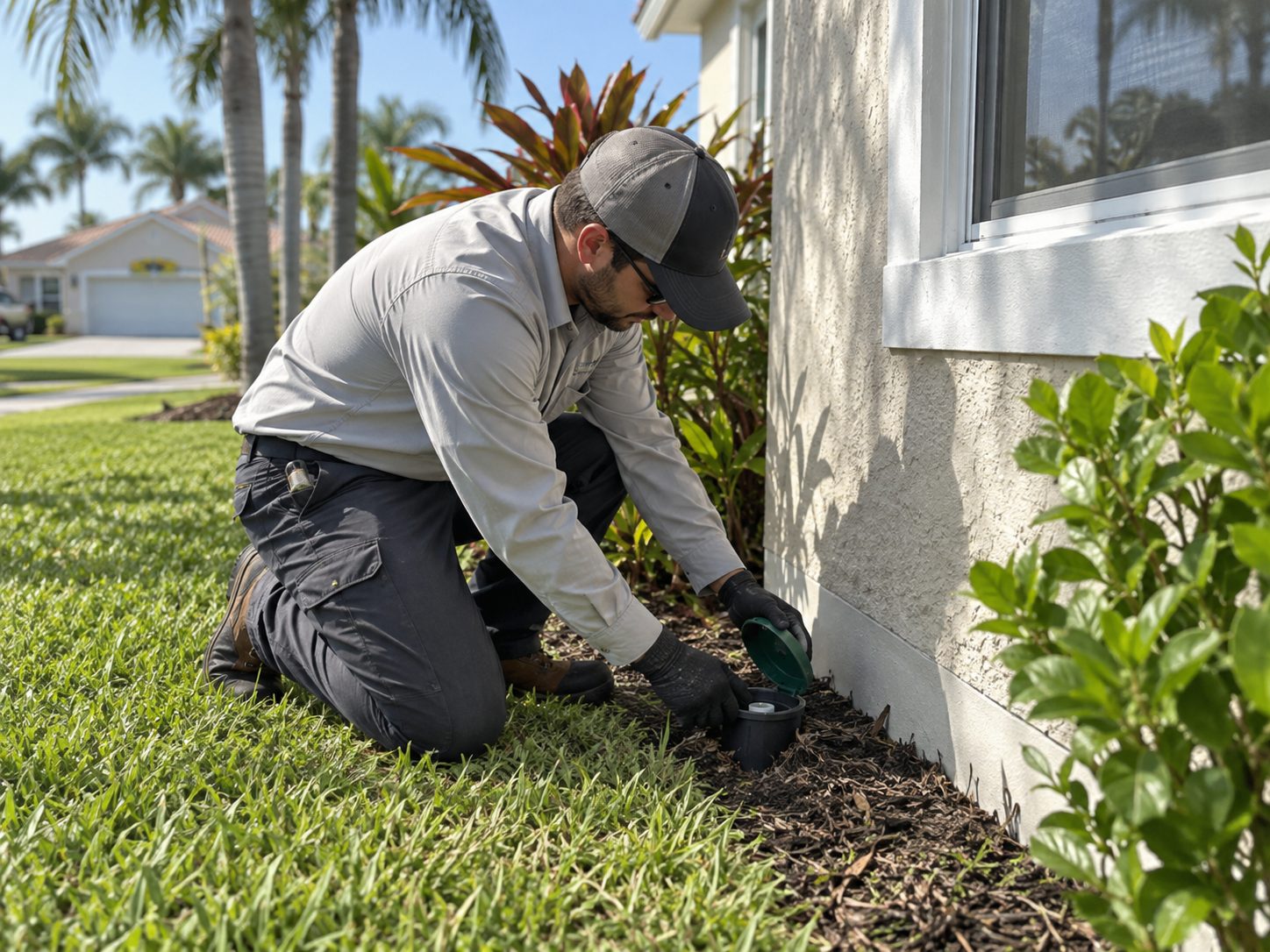
Bait systems are another common preventive service, especially where long-term monitoring is a priority or where soil treatment is less practical. Stations are installed in the ground around the structure and checked at regular intervals. When termites find the bait, they feed on it and carry the active ingredient back to the colony, gradually suppressing or eliminating it.
What property owners should understand is that baiting is not passive in the sense of set it and forget it. The value comes from the monitoring. Stations need to be inspected on schedule, serviced when bait is consumed, and kept accessible. If the service lapses, the system loses much of its preventive value.
Baiting can be an excellent fit for properties with wells, complex hardscaping, sensitive drainage concerns, or owners who want ongoing professional oversight. It also provides useful information over time. A station that suddenly becomes active tells you something about termite pressure on the site, even if there is no damage inside the structure yet.
In practice, some of the best prevention programs use judgment rather than brand loyalty. Certain properties do well with bait systems as the primary approach. Others benefit more from a well-executed liquid treatment, with annual inspections to monitor conditions. The right choice depends on the building, the site, and the termite species involved.
Moisture management is termite control, whether people call it that or not
Many owners think termite prevention begins and ends with pesticides. That is too narrow. Moisture correction is one of the most valuable termite prevention services available, even when it is performed by a plumber, roofer, drainage contractor, or crawl-space specialist rather than a pest company.
Subterranean termites are strongly drawn to damp conditions. A chronic leak at a hose bib, condensate line, shower trap, or crawl-space plumbing run can make a localized part of the building far more attractive. Wood that stays damp also softens and decays, making it easier for termites to exploit.
One recurring example is the hidden crawl space with poor ventilation and a torn vapor barrier. The owner may not notice anything from inside the living area, yet humidity under the house remains elevated for long stretches. Over time, joists and subflooring become more vulnerable. Add a small plumbing seep, and you have the kind of environment where termites and wood-destroying fungi can both gain ground.
The most effective preventive programs nearly always include recommendations like improving drainage, repairing leaks, redirecting downspouts, lowering exterior soil levels, and separating wood materials from soil contact. These are not side notes. They are core parts of real termite prevention.
Wood treatment and borate applications
For certain structures, direct wood treatment is worth considering. Borate products can be applied to raw wood during construction, renovation, or in accessible unfinished spaces. They penetrate the wood and create long-lasting resistance to termites and some wood-destroying fungi.
This is especially useful in additions, exposed framing during remodels, crawl spaces, attics, and outbuildings where bare wood is accessible. It is less useful when surfaces are sealed, painted, or hidden behind finished materials, because penetration becomes limited or impossible.
Borate treatment is not a substitute for full-site prevention where subterranean pressure is high, but it can be an excellent layer of protection. Builders and owners who use it during renovation often appreciate that it is easiest and most cost-effective before insulation and drywall go in. Once walls are closed, options narrow.
Pre-construction protection for new buildings
The best time to think about termites is before a slab is poured or framing goes up. Pre-construction termite work can include soil treatment before foundation placement, treatment of fill areas, protection around plumbing penetrations, and wood treatment in vulnerable assemblies.
This phase matters because access is still easy. Once patios, landscaping, driveways, and interior finishes are complete, the same treatment is more complex and often more expensive. Builders who coordinate termite prevention early tend to get more complete coverage with less disruption.
For property owners commissioning a custom build or major addition, it is worth asking detailed questions. What method is being used? Which parts of the structure are being protected? Is there documentation of the treatment? What warranty, if any, comes with it? Too many owners assume this step is automatic and comprehensive, only to find later that the protection was minimal or poorly documented.
The service plan that makes sense year after year
Annual or semiannual monitoring is where many preventive programs succeed or fail. Termite control is not just about the initial treatment. Conditions change. Soil shifts. Leaks develop. Garden beds get raised. Deck repairs introduce new wood-to-soil contact. An owner who installs prevention once and never revisits the issue may still end up with a problem later.
A practical service plan usually includes these elements:
- A detailed professional inspection at regular intervals, often once a year.
- Follow-up treatment or bait station servicing based on the protection method in place.
- Written notes on moisture issues, wood contact points, and structural vulnerabilities.
- Prompt correction of leaks, drainage defects, and landscaping problems.
- Documentation kept on file for future resale, refinancing, or warranty claims.
That kind of record can save a great deal of confusion. When a buyer asks whether the property has had termites, the owner can answer clearly: yes or no, what treatment was done, when inspections occurred, and whether any damage was repaired. That is much stronger than relying on memory.
Warning signs property owners should never ignore
Preventive care works best when owners know what merits a quick call. Some signs are dramatic, but many are subtle enough to dismiss if you have not seen them before.
Here are a few that justify a professional look:
- Mud tubes on foundation walls, piers, or masonry surfaces
- Swarms of winged insects indoors or just outside during warm, humid periods
- Discarded wings near windows, doors, or light sources
- Paint that blisters without an obvious moisture source
- Wood trim or flooring that sounds hollow or feels unusually soft
Not every one of these signs confirms active infestation. Moisture can mimic termite damage in some cases, and flying ants are often mistaken for termite swarmers. Still, the cost of checking is small compared with the cost of waiting.
Choosing among Termite Control Services without getting oversold
Property owners are often approached with broad promises: total protection, permanent elimination, or one-time solutions that supposedly solve everything. Experience says to be cautious with those claims. Good termite work is specific. It accounts for species, structure type, access limitations, moisture conditions, and the service history of the property.
When comparing providers, focus less on sales language and more on the quality Termite Control Services of the inspection, the clarity of the proposed scope, and the logic behind the recommendation. If one company prescribes an expensive full treatment without discussing drainage, wood contact, or inspection findings, that is a weak sign. If another company walks the site carefully, points out contributing conditions, explains the strengths and limits of each option, and provides a clear service record, that is usually a better sign.
Owners should also ask how inaccessible areas are handled. A proposal is only as good as the access available. If a crawl space is too tight to inspect fully, or if finished basements conceal critical areas, that limitation should be documented honestly. Pretending everything has been covered when it has not is how preventable problems turn into costly repairs.
Special concerns for rental and commercial properties
Rental properties deserve extra vigilance because tenants often notice symptoms later than owners would. Storage against garage walls, delayed reporting of plumbing leaks, and heavy wear on exterior doors and trim all make inspections more important. A landlord with a multi-unit property should think in terms of repeatable preventive systems, not one-off responses. Scheduled inspections, documented repair protocols, and strict moisture maintenance matter more than improvised treatment after complaints arise.
Commercial buildings present different challenges. Restaurants, offices, retail suites, and warehouses may have slab penetrations, inaccessible tenant improvements, irrigation-heavy landscaping, and utility rooms that stay warm and damp. The visible front of the property may look excellent while service corridors or rear utility areas harbor the real risk. In those settings, termite prevention needs coordination between pest professionals, maintenance staff, and sometimes property managers who control vendor access and repair budgets.
What prevention usually costs compared with neglect
Exact pricing varies by region, structure size, and Termite Control Services treatment method, so broad estimates are safer than firm numbers. Still, the pattern is consistent. Preventive inspections and monitoring plans are modest compared with the cost of structural repairs. A localized moisture correction might cost a few hundred dollars. A comprehensive treatment may cost more upfront, especially on large or complex structures, but serious repairs to framing, flooring, trim, and finishes can quickly move into the thousands or tens of thousands.
And repair is not just material cost. Once damage is found, there is often demolition, reconstruction, schedule disruption, and in some cases temporary loss of use. For landlords and commercial owners, that can mean vacancy, tenant complaints, or construction timing that affects revenue. Prevention is easier to schedule and far less intrusive.
The practical mindset that protects buildings
The most successful property owners do not treat termites as a once-in-a-lifetime event. They treat them as a manageable building risk, much like drainage failure or roof leaks. They understand that no single product can replace observation, maintenance, and periodic professional review.
A sound prevention strategy usually looks unglamorous from the outside. The grading is correct. Mulch is not piled against the siding. Firewood is stored away from the structure. Crawl spaces stay dry. Annual inspections happen on schedule. Treatment records are easy to locate. Small leaks get repaired before they become chronic. That is what durable termite prevention often looks like in real life.
When owners approach Termite Control Services with that mindset, they tend to spend less over time and avoid the worst surprises. The goal is not panic, and it is not over-treatment. It is steady, informed control of the conditions that allow termites to thrive. That is the kind of prevention every property owner should know, and the kind that pays for itself long before visible damage ever appears.
Maximum Pest Control
836 NE 7th Terrace Suite #5
Cape Coral, FL 33909
+1 239-772-7363
FAQ About Termite Control Services
What are two signs of a termite infestation?
Mud tubes along a foundation and piles of shed wings near doors or windows are two signs to investigate. Mud tubes are associated with subterranean termites. A licensed inspector can identify the insect and assess whether there is active infestation.
How many years does a termite treatment last?
There is no single timeline for all treatments. The method, site conditions, and maintenance affect how long protection lasts. Bait systems rely on monitoring and service. Ask the provider for the recommended inspection schedule and the terms of any coverage.
Is Termite Treatment Expensive in Cape Coral?
Cost depends on the termite species, the size and construction of the property, the extent of activity, and the treatment method. Request a written estimate after inspection and ask whether monitoring, follow-up visits, and renewals are included.